 Call Us:
 Mail Us:
High School Equivalency in Turkey (Denklik) 2026: Complete e-Devlet Guide
 By Ammar
- 5 min read
High-school equivalency in Turkey — known as Denklik — is the single most important step for any foreign student who wants to continue their university educati…
High-school equivalency in Turkey — known as Denklik — is the single most important step for any foreign student who wants to continue their university education in Turkey, register for open university programmes, or in some cases apply for a driving licence when their education isn't at the required level. The certificate is issued by Turkey's Ministry of National Education (MEB), and in 2026 the process is faster and easier than ever thanks to the e-Devlet online portal. This guide walks you through everything you need to complete the process successfully.
What exactly is Denklik?
Denklik is an official equivalency certificate issued by Turkey's Ministry of Education, confirming that your foreign high-school diploma is equivalent to a Turkish high-school diploma (Lise Diploması). Without this certificate, you can't apply to Turkish public or private universities, and you can't register for open university programmes.
When do you need Denklik?
- To apply to a Turkish university (public or private).
- To register for open university education (AÖF / AUZEF / ATA-AÖF).
- To apply for certain government-sector jobs that require documented education.
- To prove your education level in residence or citizenship procedures.
Who issues Denklik?
Denklik is issued by the Provincial Directorate of National Education in the province where you live, under the supervision of the Ministry's General Directorate for Foreign Affairs. Applications can be submitted in two ways:
- Online through the e-Denklik portal (denklik.meb.gov.tr), accessed via e-Devlet.
- In person at your provincial education directorate with original documents.
Documents you'll need
- Original high-school diploma: must be certified by the Ministry of Education in the country of issue, plus authenticated by the Turkish consulate in that country (an Apostille for countries that signed the Hague Convention, or a consular legalisation otherwise).
- Transcript: must show every subject and grade for each academic year, with the same level of authentication as the diploma.
- Certified Turkish translation: the diploma and transcript must be translated by a sworn translator (Yeminli Tercüman) and notarised at a Noter office inside Turkey.
- Passport copy (the page with your personal info).
- Turkish residence permit copy (Kimlik) or temporary protection document.
- For Syrian applicants specifically: special procedures may allow acceptance without Apostille in some cases.
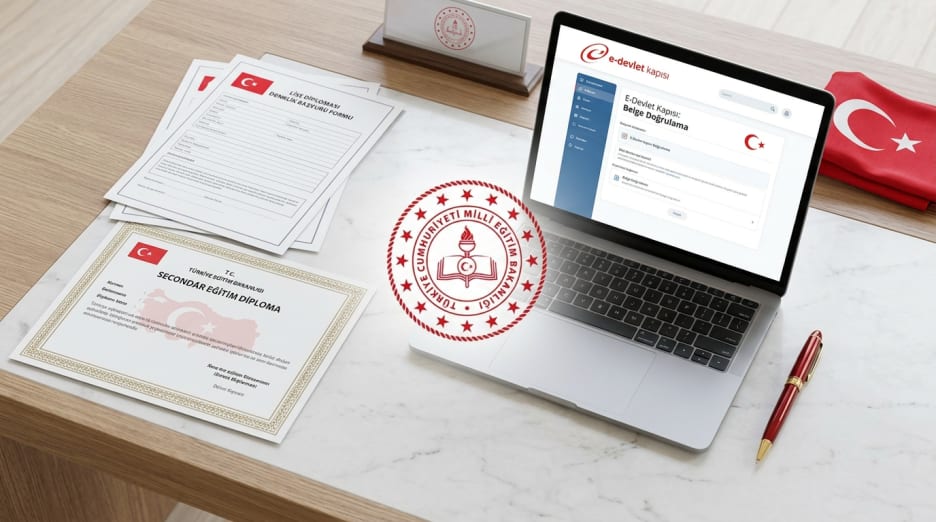
Step-by-step: applying via e-Devlet
- Log into e-Devlet using your residence ID and password.
- Search for "Denklik Başvurusu" or go directly to denklik.meb.gov.tr.
- Choose "Lise Denkliği" (high-school equivalency) from the options.
- Fill in your personal details: full name, date of birth, residence ID number.
- Upload scans of your translated and notarised documents (PDF or JPG, usually capped at 5 MB per file).
- Pick the education directorate of your province to handle the case.
- Pay the small processing fee, if any, by credit card.
- Track your application status from e-Devlet — you'll see "Under Review", "Needs Revision", or "Approved".
Expected timeline
In most cases, Denklik is issued within two to six weeks. The exact time depends on:
- How complete your documents are and whether the certifications are correct.
- Which province you applied in — Istanbul and Ankara tend to be the slowest.
- The season — turnaround is faster outside university admission windows (June/August).
Fees
Denklik itself is essentially free — official government fees are minimal and usually fall in the 50–150 TL range. However, you'll also pay for:
- Certified translation (300–800 TL for both documents).
- Notary certification (200–400 TL).
- Consular legalisation in your home country (varies by country).
What if your Denklik request is rejected?
Common reasons for rejection:
- Incomplete documents or missing required authentications.
- Differences in name spelling between the diploma and your passport.
- Your school's total number of years doesn't match the Turkish 12-year system.
- Doubts about the diploma's authenticity (requires extra verification).
If you're rejected, you can:
- File an appeal through e-Devlet within 30 days.
- Complete any missing documents and re-submit.
- Contact the regional directorate directly to understand the exact reason.
- In some cases, sit the Ministry's "Denklik Exam" to validate your academic level.
After you've received your Denklik
- Apply to universities — public or private — attaching a copy of your Denklik to each application.
- Register for open education (AÖF / AUZEF / ATA-AÖF).
- Keep multiple copies — every subsequent university procedure will ask for one.
- If you plan to study abroad later, you may need to have the Denklik authenticated by your consulate and by the Turkish Foreign Ministry for international use.
Tips that speed up your Denklik
- Double-check every document before submitting. A single typo in your name or birth date can delay the process by at least two weeks.
- Choose a sworn translator accredited by the notary in your district to avoid translation rejections.
- The e-Devlet online route is faster than in-person in most provinces.
- If you're targeting a specific university, ask its international students office — many have a Denklik help desk.
- Avoid agencies that charge 3,000–5,000 TL. The process is straightforward and you can do it yourself for a fraction of that.
Final thoughts
High-school equivalency in Turkey in 2026 is no longer the bureaucratic obstacle it used to be. Thanks to digital transformation and the e-Devlet portal, any student or resident can apply for Denklik themselves in minutes. What it really takes is properly authenticated documents, a certified translation, and a few weeks of patience. Once you have your Denklik in hand, the doors of Turkish universities, open education, and formal employment all open up. Start early — well before the university admission season — and you'll save yourself a lot of time and stress.