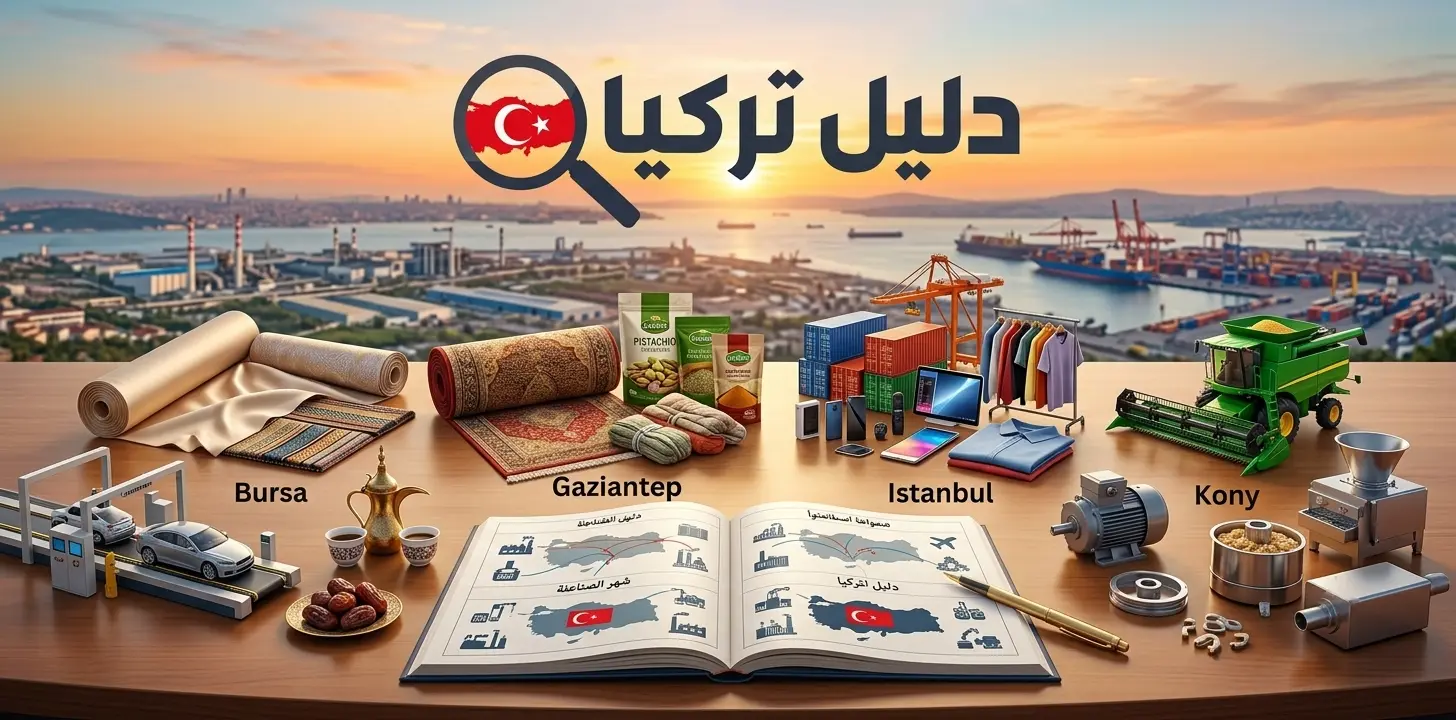
Best Turkish Regions for Each Industry: Bursa, Gaziantep, Istanbul, and Manufacturing Cities That Matter to Arab Importers Turkey is not simply one wholesale m…
Turkey is not simply one wholesale market. It is a broad network of cities and industrial regions, each with different sector strengths, production expertise, price levels, quality standards, minimum-order expectations, and logistics advantages. For this reason, selecting the right city for supplier sourcing can be as important as selecting the right product.
Many importers begin in Istanbul because it is the best-known and easiest city to reach. Later, they discover that the best factory, most competitive price, or deepest expertise for their product may be in Bursa, Gaziantep, Denizli, Kayseri, Konya, Izmir, or another industrial centre. Searching in a specialised region helps you reach real manufacturers rather than relying only on intermediaries or general trading companies.
This guide explains the most important Turkish regions for Arab importers, the sectors for which they are known, how to choose the right city for a sourcing trip or supplier search, and what you should evaluate before making a final purchasing decision.
Why factory location matters
You may find a similar product in several Turkish cities, but factory location affects important parts of the transaction. The first is price. Specialised regions usually contain a larger number of factories, suppliers, local subcontractors, and supply-chain services. This increases competition and makes access to raw materials and technical expertise easier.
The second factor is quality and experience. A factory located in a city known for a specific sector often has a better understanding of market specifications, popular models, export requirements, and common problems related to that product. For example, a home-textile supplier in Denizli may have deeper knowledge of towels and bed linen than a general trading company in another city.
The third factor is logistics. Proximity to ports such as Mersin, Izmir, or Istanbul, or to major road routes, affects inland transport cost and shipment preparation time. However, being close to a port does not always mean the final price is lower. You must compare factory price, inland transport, freight options, and the total time needed until goods reach your country.
Location also affects how easily you can visit and inspect suppliers. If you plan to meet several factories in the same sector within a few days, travelling to a specialised city saves significant time compared with moving between distant cities to meet only one supplier in each place.
Istanbul: trade, exhibitions, and diverse product categories
Istanbul is often the first sourcing destination for Arab importers. This is not only because it has international airports, extensive hotel options, and broad logistics services, but also because it is a major commercial centre that brings together factories, trading companies, agents, exhibitions, warehouses, and exporters. It is especially suitable for buyers who want to study several sectors in one trip or meet a wide range of suppliers before narrowing their options.
Istanbul and its surrounding industrial areas have a strong presence in ready-made clothing, modest fashion, children’s wear, bags, shoes, household goods, furniture, lighting, cosmetics, packaging, hotel supplies, food products, stationery, gifts, and selected industrial products. Areas such as Beylikdüzü, İkitelli, Merter, Laleli, Zeytinburnu, Güngören, Esenyurt, Tuzla, Gebze, and nearby industrial zones offer different opportunities depending on the sector.
For clothing, areas such as Merter, Güngören, and Zeytinburnu are important for wholesale trade, workshops, and branded garment companies. You may find factories, exporters, or distributors there, but you should distinguish between a company that designs and manufactures its own products and a company that collects goods from multiple workshops. This difference matters when you need private labelling, large quantities, or consistent quality.
For furniture and interior products, Istanbul offers a broad range of suppliers and showrooms, particularly for home furniture, office furniture, hotel furniture, lighting, kitchens, and home accessories. However, it may not be the most competitive location for every furniture category, so it should be compared with Kayseri, İnegöl, and Bursa depending on product type and order size.
One of Istanbul’s greatest advantages is its role as a centre for international trade fairs. A specialised exhibition allows you to meet dozens or hundreds of suppliers in a few days, compare designs, prices, and specifications, and understand new trends in the sector. However, attending a fair does not replace factory visits, sample approval, or independent inspection before payment.
The main issue requiring attention in Istanbul is the large number of intermediaries. The presence of many trading companies is not inherently negative, because some offer useful services such as product consolidation and export follow-up. However, you should never assume that every company owns a factory. Ask clearly about the role of the party you are dealing with, production location, and the manufacturer’s identity where this matters to your transaction.
Bursa: textiles, automotive products, furniture, and specialised manufacturing
Bursa is located in northwestern Turkey and is an important industrial city for importers looking for textiles, fabrics, automotive components, spare parts, furniture, and selected mechanical industries. Its relative proximity to Istanbul makes it practical to visit as part of a multi-city sourcing trip.
Bursa has a strong history in textile manufacturing, making it an important option for buyers seeking fabrics, technical textiles, upholstery fabrics, selected garment products, and materials used in multiple industries. When sourcing in this sector, do not rely on a general fabric name. Define the composition, weight, width, weave type, colour, washing resistance, and packaging method.
Bursa is also an important region for automotive products and spare parts. Importers can find suppliers of vehicle components, rubber, plastic, and metal parts, accessories, and some products used in maintenance services or commercial vehicles. However, this sector requires more technical care than general trade. You should confirm part numbers, vehicle compatibility, technical specifications, warranty terms, and quality certificates required in your importing country.
For furniture, Bursa and its surrounding areas can be suitable for selected home-furniture, upholstery, and wood-product categories. The nearby İnegöl region is particularly known for a wide variety of furniture production, including bedrooms, living-room sets, tables, chairs, and hospitality products. This makes it a useful destination for distributors, furniture traders, and hotel projects.
When buying from Bursa, focus on visiting the factory or showroom and request details on production capacity and execution time. In furniture and textile products, quality can differ substantially depending on wood type, fabric, foam, fittings, and accessories. Do not compare prices until specifications have been standardised.
Gaziantep: carpets, plastics, food, and packaging
Gaziantep is one of the most important industrial cities in southeastern Turkey. It has clear strength in carpets and rugs, textiles, food processing, plastics, packaging, paper products, and selected industrial goods. Its location and proximity to Middle Eastern markets give it particular relevance for Arab importers.
The city is known for machine-made carpets, rugs, and flooring products, making it an important destination for home-furnishing traders, hotels, residential projects, and retail businesses. When buying carpets, do not select based only on design or colour. Define the material, such as polypropylene, polyester, acrylic, or wool; pile height; density; weight; edge finishing; size; backing type; and packaging method.
In food products, buyers may find goods such as legumes, pastries, confectionery, spices, pistachio products, canned foods, and selected food raw materials. However, food importing requires separate planning because requirements differ by destination country. These may include food registration, health certificates, laboratory testing, Arabic labelling, shelf-life rules, and storage and transport conditions.
Gaziantep’s plastics and packaging sector is also important, especially for containers, bags, plastic films, and selected household and industrial products. Importers seeking private-label packaging should define material type, thickness, dimensions, number of printing colours, minimum production quantity, mould or cylinder cost, and packing method.
The primary advantage of Gaziantep is its industrial specialisation and broad factory base in these sectors. However, do not assume that every company exports directly. Ask about experience in your market, export terms, ability to provide required documents, and whether the company can load containers at the factory or transport goods to the export port.
Denizli: towels, home textiles, and cotton products
Denizli is a city that every importer interested in towels, bed linen, bathrobes, hotel textiles, and cotton home products should know. The region has long experience in home-textile production and offers options ranging from economical products to higher-quality hotel and branded goods.
When selecting a supplier in Denizli, define the product precisely. Do you need hand towels, bath towels, hotel towels, bathrobes, bed covers, or bed sets? Then specify weight, material such as cotton or cotton blend, colour, dimensions, stitching, embroidery, logo placement, and packaging.
It is important to understand that towels should not be compared by weight alone. Check absorbency, fabric softness, colour fastness, shrinkage after washing, and edge quality. If you target hotels, hospitals, or hospitality projects, verify whether the product can withstand frequent use and repeated washing.
Denizli is highly suitable for private-label home-textile brands, but customised colours, embroidery, or packaging may raise the minimum order quantity. Request an approved sample before production and clarify whether sample, design, or branding costs will be deducted from the final commercial order.
Kayseri: furniture, mattresses, and household products
Kayseri is one of Turkey’s recognised centres for furniture, mattresses, sofas, and selected household products. It is important for importers seeking competitively priced furniture, residential and commercial furnishing, or products related to bedrooms, living rooms, and hotels.
In furniture, you must separate appearance from quality. An attractive image is not enough to determine product value. Ask about the type of wood, MDF, particleboard, material thickness, veneer or paint, metal accessories, hinges, packing system, assembly method, and warranty.
For mattresses, define the spring or foam type, density, thickness, protective layers, exterior fabric, and compression or vacuum-packing options where available. Large products such as furniture and mattresses require careful freight analysis because volume can matter more than weight in determining transport cost.
If you are buying furniture for a hotel or residential project, request a bill of quantities, technical drawings, and samples of fabrics and colours. Do not rely only on catalogues, because differences in colours, dimensions, and assembly method can affect the entire project.
Konya is an important city for importers in agricultural machinery, equipment, spare parts, metal industries, and selected construction and production products. It is suitable for traders serving farms, maintenance workshops, contractors, and agricultural projects.
When buying a machine or spare part from Konya, make your decision based on technical specifications rather than appearance or price alone. Request a technical catalogue, model number, origin of key components where necessary, power or capacity, list of consumable parts, warranty, operating instructions, and spare-part availability.
If the machine uses electricity, an engine, or a hydraulic system, verify that it is compatible with voltage, fuel type, and operating conditions in your country. You should also know whether the supplier provides remote technical support, training, or a spare-parts list that can be ordered later.
Konya’s strength lies in specialised manufacturing, but the equipment sector requires serious inspection before shipping. It is better to test the machine, watch it operating through a live video call or factory visit, and arrange independent inspection for high-value orders.
Izmir and Manisa: food, agriculture, and port-linked exports
Izmir is one of the principal cities in western Turkey. It benefits from strong logistics access and proximity to a major port, as well as a presence in food, agriculture, industrial goods, and international trade. Nearby Manisa has diverse industrial activity and forms an important extension of the Aegean production and export region.
Importers can search this area for food and agricultural products, dried fruits, olive oil, selected canned goods, industrial products, equipment, and packaging materials. However, every food product should be assessed against the rules of the importing country, not only against product quality or price.
If you are importing olive oil, packaged foods, or dried fruits, verify production and expiry dates, storage requirements, packaging type, certificate of origin, health documentation, Arabic labelling, ingredients, and food-allergen information where applicable.
The advantage of this region is easier access to export services and ports. However, you should still compare inland transport and freight from different ports because the best route depends on the destination country, shipment size, and container type.
Mersin and Adana: a logistics gateway to the Middle East
Mersin is not only a city with industrial activity; it is also an important logistics centre for importers shipping to the Middle East, the Gulf, and North Africa. The port makes it a practical point for consolidating goods from many Turkish cities and moving them by sea, particularly commercial cargo and full containers.
The Mersin and Adana area has activity in food, agriculture, packaging, industrial products, and some export-related sectors. It can be useful for importers who want to reduce inland transport when suppliers are located in southern Turkey or when cargo will depart through Mersin Port.
However, choosing a supplier near Mersin only because of the port is not enough. The best supplier in terms of quality or price may be in Gaziantep, Konya, or Bursa, while shipping through Mersin can still be practical. The correct approach is to compare total landed cost, not only factory-to-port distance.
How to choose the right city for your product
Start with the sector, not the city. Define your product precisely, then identify cities known for producing it. Build a list of five to ten suppliers across two or three regions where possible. This prevents you from becoming dependent on one supplier or one city.
Then compare suppliers using the same criteria: sample quality, price, minimum order quantity, production time, customization ability, payment terms, export documents, proximity to the port, and experience exporting to Arab markets.
Do not make factory price your only criterion. A supplier in a distant city may cost slightly more in inland transport but offer better quality, a lower minimum order quantity, stronger packaging, or faster production. Conversely, a supplier close to the port may be cheaper but unable to meet your specifications or schedule.
How to organise an industrial sourcing trip in Turkey
If you plan to travel, do not book the trip before arranging supplier meetings. Send your requests at least two or three weeks in advance and ask for written confirmation of appointment time, location, contact person, and the products that will be ready to show.
Keep the travel schedule logical. If your sector is clothing or general trade, begin in Istanbul. If you are seeking carpets, packaging, and food products, plan for Gaziantep. If you are interested in furniture, consider Kayseri, Bursa, or İnegöl. If your product is home textiles, add Denizli to the itinerary.
During visits, do not limit yourself to a meeting in the sales office. Ask to see the warehouse, production line, quality-control department, and packing area. Take photographs of samples with supplier permission, and record item codes, prices, specifications, minimum order quantities, and production times. After meeting several factories, you will be able to compare objectively rather than relying on memory.
Questions to ask suppliers in every city
- Are you a manufacturer or a trading company, and where does production take place?
- What is the minimum order quantity for each model, colour, or size?
- What is your monthly production capacity and the lead time for my order?
- Can I request a sample before bulk production?
- What are the exact technical specifications of the product?
- What packaging do you use, and can you apply my private label?
- What is the quoted Incoterm: EXW, FOB, CIF, or another term?
- Which port is most suitable for shipping, and who pays inland transport?
- What documents and certificates can you provide?
- Do you have experience exporting to my country or a similar Arab market?
- Do you accept independent pre-shipment inspection?
- What are your payment terms, and what happens if production is late or quality does not match the agreement?
Common mistakes when selecting a Turkish sourcing region
- Going only to Istanbul and assuming the best factory for every sector is located there
- Choosing a city based on fame rather than industrial specialisation
- Comparing prices for products with different specifications or quality grades
- Assuming a supplier is a factory without a visit, verification, or live video call
- Ignoring transport cost from the industrial city to the export port
- Travelling without confirmed appointments or a clear supplier list
- Buying from the first factory because of time pressure or a promotional offer
- Failing to request samples or inspection before transferring a large payment
- Ignoring customs and certification requirements in the importing country
- Using an intermediary without clearly defining their role, fees, and responsibility
The best region in Turkey is not the most famous city. It is the city that combines the right supplier for your product, required quality, sufficient production capacity, workable shipping, and a total landed cost that allows a realistic profit. Start with your market needs, identify the relevant industrial specialisation, verify the supplier, and only then make the purchasing decision.