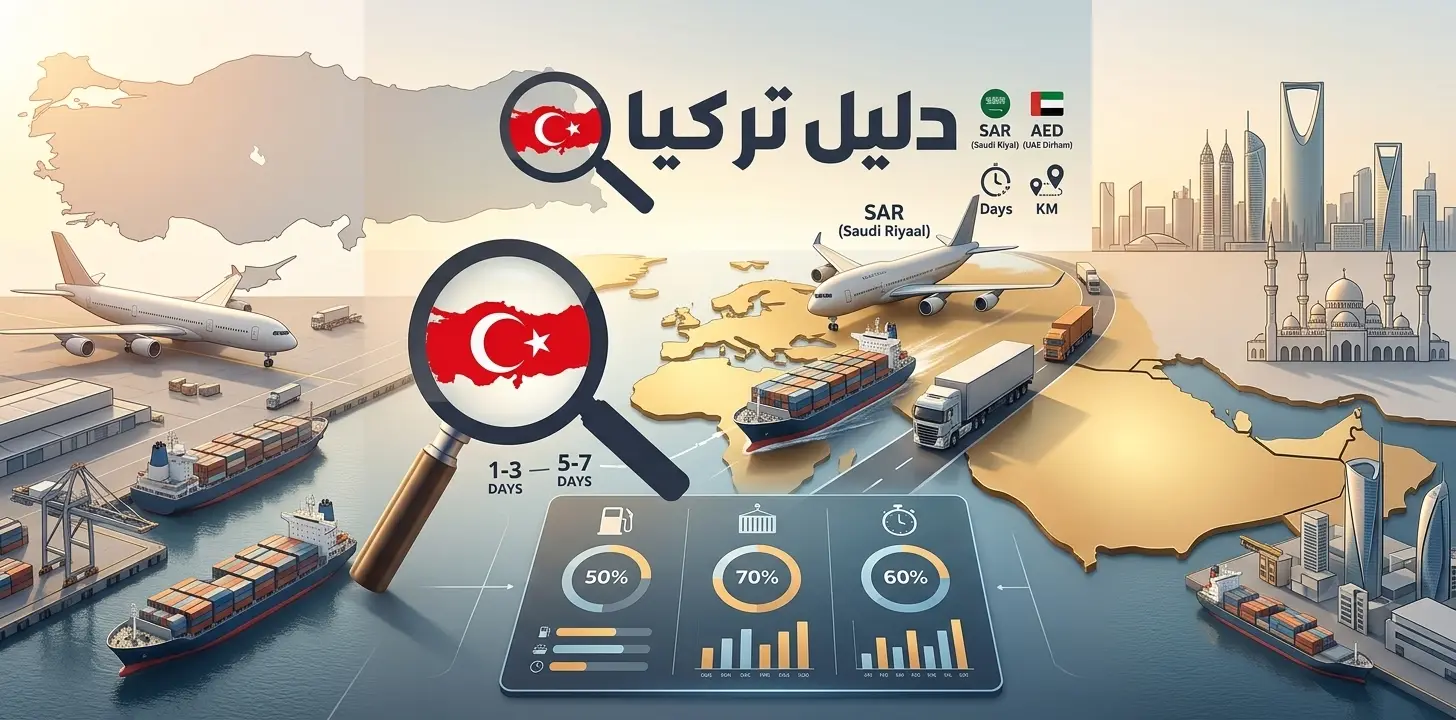
Shipping Costs from Turkey to Saudi Arabia and the UAE: Prices, Transit Times, and How to Calculate the Real Cost Shipping costs from Turkey to Saudi Arabia or…
Shipping costs from Turkey to Saudi Arabia or the United Arab Emirates are not a fixed number that can be taken from one quotation and applied to every shipment. The price changes according to the collection city in Turkey, destination port, cargo type, weight and volume, shipping method, export season, port charges, fuel costs, container availability, and the selected sea, road, or air route.
For this reason, the right question is not, “How much does shipping from Turkey cost?” The better question is, “What will my total landed shipping cost be from the Turkish factory door to my warehouse in Saudi Arabia or the UAE?” This distinction matters because some freight quotations look inexpensive at the beginning but exclude important charges that appear later at the port or during delivery.
This guide explains the available shipping methods from Turkey to Saudi Arabia and the UAE, expected transit times, the cost components you should understand, the difference between full-container and less-than-container shipping, air and road freight, and how to request a clear quotation without surprises.
How to choose the right shipping method
There is no single shipping method that suits every type of cargo. The choice depends on the balance between speed, cost, shipment size, and product characteristics. Heavy or bulky goods such as construction materials, furniture, ceramic, and machinery are generally suitable for sea freight. Samples, urgent spare parts, lightweight clothing, small electronics, and high-value goods may suit air freight. Road freight can also be practical for certain shipments to Saudi Arabia, depending on the available route, cargo type, and required timing.
Before requesting a rate, define the following details accurately: factory or warehouse city in Turkey, destination city or port, number of cartons or packages, total weight, chargeable volume for air freight, cargo dimensions, product type, invoice value, and whether you need door-to-door service or port-to-port service only.
Every missing detail makes the quotation less accurate. If you tell a freight forwarder only that you have “clothing cargo,” you may receive a rough estimate that is not useful. If you provide carton count, weight, dimensions, collection point, and delivery point, the quotation becomes much closer to the real cost.
Sea freight from Turkey to Saudi Arabia
Sea freight is the most widely used option for heavy commercial cargo and larger volumes going to Saudi Arabia. Many shipments arrive through ports such as Jeddah Islamic Port or King Abdulaziz Port in Dammam, then move by road to the final city. The best port depends on the importer’s location inside Saudi Arabia, available shipping lines, and inland transportation cost.
Shipments may depart from Turkish ports such as Mersin, Ambarlı, Istanbul, Izmir, or others, depending on factory location and sailing service. Some services are direct or nearly direct, while others require transshipment through an intermediate port. This affects transit time and the risk of delay.
Published freight-service indications show direct Turkish-port-to-Jeddah transit of around 6 to 10 days on some services, while other routings can take longer because of stops, transshipment, or port congestion.[web:166] Some freight calculators show broader estimates of around 17 days or more for certain Mersin-to-Jeddah routes.[web:156]
Do not rely on the sea-transit number alone. Add the time needed to collect goods from the factory, prepare export clearance, bring the container into the Turkish port, complete Turkish customs procedures, discharge and clear goods in Saudi Arabia, and move them inland. The sea voyage itself may be short, but the total factory-to-warehouse timeline can be considerably longer.
Sea freight from Turkey to the UAE
The UAE, particularly Dubai and Jebel Ali Port, is one of the main sea-freight destinations from Turkey. This route suits importers shipping full containers or consolidated cargo of Turkish products for use inside the UAE or for re-export to GCC countries, Africa, and other markets.
Sea transit from Turkey to Jebel Ali varies by origin port, shipping line, and whether the shipment is full-container or less-than-container cargo. Some freight companies indicate approximate transit times of 12 to 18 days from Istanbul or Mersin to Jebel Ali for FCL or LCL services, depending on routing, congestion, and service type.[web:162] Other sources show a broader range of 20 to 30 days for sea freight or consolidated shipments, particularly where consolidation, transshipment, or port waiting is involved.[web:170]
For that reason, when requesting a UAE quotation, ask the freight forwarder to confirm whether the stated transit time covers only port-to-port sailing or also includes factory collection, export clearance in Turkey, and delivery to your address in Dubai, Abu Dhabi, Sharjah, or another emirate.
Full-container load (FCL) or less-than-container load (LCL)?
Full-container load, or FCL, means your shipment uses an entire container dedicated to your cargo, such as a 20-foot, 40-foot, or 40-foot high-cube container. This option is often better when the volume is large or when your cargo can use enough container space. It also gives you more control over loading and packaging and reduces repeated handling with other importers’ goods.
Less-than-container load, or LCL, means your goods share container space with cargo belonging to other importers. It is suitable when your quantity is too small to justify a full container. However, it can be slower and more complicated because goods must be consolidated in Turkey and separated at destination. Consolidation, handling, and deconsolidation charges may be added and may not appear in the basic ocean-freight figure.
Do not assume that LCL is always cheaper. When your cargo volume approaches the capacity of a 20-foot container, FCL may become more economical after consolidation, deconsolidation, and local port fees are included. Ask the freight forwarder for a written FCL-versus-LCL comparison when your shipment is medium-sized or relatively large.
How full-container cost is calculated
Container cost is not limited to ocean freight. A shipment usually involves several cost items that should be understood before you decide:
- Transport from the factory to the Turkish port
- Container loading or preparation charges
- Export and customs-clearance charges in Turkey
- Main ocean freight
- Documentation or bill-of-lading fees
- Marine insurance, if selected
- Destination-port charges
- Local handling and discharge charges
- Customs duties and taxes based on product type
- Customs-broker fees
- Transport from port to the importer’s warehouse
- Storage or demurrage charges if clearance is delayed
This is why a container quotation from Turkey to Jeddah or Jebel Ali may appear low, while substantial local charges arise at destination. The solution is to ask clearly: What is included in this price? What will I pay at destination? Is the quotation port-to-port, factory-to-port, or door-to-door?
Air freight from Turkey to Saudi Arabia and the UAE
Air freight is suitable when speed matters more than transportation cost. Traders commonly use it for samples, lightweight high-value goods, urgent orders, spare parts, and seasonal products that may lose value if they arrive late.
Actual air transit can be very short compared with sea freight, but the full timeline depends on when goods are delivered to the forwarder, flight booking, security screening, export procedures, destination-airport clearance, and final delivery. Some air-freight services to Dubai indicate approximate timelines of 4 to 8 working days depending on service type, clearance, and delivery arrangements.[web:170]
With air freight, charges are not calculated only by actual weight. They may be calculated by volumetric weight, which is based on carton dimensions. This means a light but bulky shipment can cost more than a heavier but compact shipment.
Before selecting air freight, ask the forwarder to calculate both actual and volumetric weight, then compare the freight cost with your expected margin. Air freight may be useful for samples or a first small shipment, while sea freight may be better for the main commercial order.
Road freight from Turkey to Saudi Arabia
Road freight can be a suitable option for selected shipments going to Saudi Arabia, especially when you need a shorter transit time than sea freight but do not want the cost of air transport. The service depends on available land routes, border procedures, cargo type, transit countries, and vehicle configuration.
Published estimates from logistics providers suggest that road transport from Turkey to Saudi Arabia can often take around 9 to 13 days in some cases, although the actual duration varies according to collection point, delivery point, and border procedures.[web:159] Other routing estimates indicate that the fastest non-air alternative may approach eight days on certain corridors, but this should not be treated as a fixed promise for every shipment.[web:161]
Road freight requires careful attention to documents and transit restrictions, and it may not be appropriate for all products or shipment sizes. Before selecting it, confirm the exact route, insurance, loading and delivery points, cargo tracking, and any border-related fees or risks with the freight company.
What increases or reduces freight cost?
Many factors can change the cost of shipping from Turkey to Saudi Arabia or the UAE, even for the same product:
- Factory location: Moving cargo from Gaziantep, Konya, Bursa, or another inland city to the port costs differently from moving it from a factory near Mersin or Istanbul.
- Shipment size: A full container is fundamentally different from LCL cargo or carton-based shipping.
- Weight and density: Heavy goods such as ceramic and steel differ from clothing and textiles.
- Shipping season: Peak periods, holidays, container shortages, and high demand can increase rates.
- Cargo type: Dangerous goods, temperature-controlled goods, and fragile items require different arrangements and charges.
- Port and shipping line: Direct service may be faster but not always cheaper, while transshipment may reduce freight but increase time and risk.
- Insurance: Skipping insurance may reduce the immediate price but increases exposure if goods are damaged or lost.
- Destination charges: Some quotations exclude port, clearance, or final-delivery charges in the importing country.
- Exchange rate: Many freight and logistics services are priced in US dollars or euros.
How to request an accurate freight quotation
To receive a useful quotation, send specific information rather than asking generally for “shipping cost from Turkey to Saudi Arabia or the UAE.” Your request should include:
- Collection city and factory or warehouse address in Turkey
- Destination city, port, or delivery address in Saudi Arabia or the UAE
- Clear cargo description
- Number of packages, cartons, or pallets
- Gross and net weight
- Dimensions of each package or total cubic metres
- Approximate invoice value for insurance and customs purposes
- Whether cargo is FCL, LCL, air, or road freight
- Required container type, if using FCL
- Whether you need collection, insurance, clearance, and warehouse delivery
- Date when goods will be ready for shipment
Ask the freight company to break the quotation into separate cost items rather than giving one total figure only. This allows you to compare two or three companies on a clear basis and identify where additional charges may arise.
FOB and CIF for Saudi Arabia and UAE shipments
Under an FOB quotation, the Turkish supplier is generally responsible for preparing the goods for export and loading them on board the vessel at the agreed port, while you arrange the main freight, insurance, destination charges, and everything after that. This option suits importers who have a reliable freight forwarder and want more control over transport cost and shipping line selection.
Under CIF, the supplier arranges freight and insurance to the destination port, such as Jeddah or Jebel Ali. This may appear easier for beginners, but you should never assume that every cost is included until your warehouse. Customs clearance, duties, port charges, and inland transport often remain the importer’s responsibility unless another service is explicitly agreed.
No single term is best for everyone. If you import regularly and can obtain good freight quotations, FOB may give you more control and transparency. If it is your first shipment or the quantity is small, CIF may be easier, provided that you know all destination charges before the goods depart.
Marine insurance: when do you need it?
Marine insurance should not be ignored simply to reduce transaction cost. Goods can be exposed to breakage, moisture, loss of packages, damage during handling, or delay. Insurance is especially important for fragile goods, machinery, construction materials, electronics, and high-value orders.
Ask the forwarder or insurer to explain the coverage precisely: Does it cover partial damage? Does it cover loss of cargo? Are there exclusions for loading or inadequate packaging? What is required to file a claim? Always keep photographs, the invoice, bill of lading, and delivery records if damage appears.
Charges that can surprise importers at destination
Even when the freight price is clear, additional charges may arise in Saudi Arabia or the UAE if they are not planned for. These can include port-handling fees, delivery-order charges, storage, inspection fees, customs-broker fees, local transport, and container charges if the empty container is not returned within the free period.
In the UAE, charges can differ depending on whether goods enter the local market, a free zone, or are intended for re-export. In Saudi Arabia, charges differ based on product classification, regulations, taxes, and related licences. You should therefore have a customs broker or local adviser who understands your product requirements before the shipment leaves Turkey.
How to reduce shipping cost without damaging the transaction
- Consolidate products from more than one factory into one shipment where practical, while managing documents and packing carefully.
- Plan early and avoid last-minute bookings, especially during busy seasons.
- Compare two or more Turkish ports if the factory is far from the coast.
- Compare FCL and LCL when cargo volume is close to a container load.
- Improve packaging and dimensions to reduce unnecessary volume, especially for air freight and LCL.
- Ask the supplier to load the container in a way that uses space efficiently and protects goods.
- Avoid delays in sending documents or arranging clearance, as storage and demurrage can be expensive.
- Do not select the cheapest quotation only; compare transit time, destination charges, insurance, and customer service.
Common mistakes when shipping from Turkey
- Using ocean freight alone as if it were the final cost
- Not knowing whether the quotation is port-to-port or door-to-door
- Sending incomplete information to the freight company and then being surprised by a revised price
- Choosing LCL without calculating consolidation and destination deconsolidation charges
- Ignoring insurance for high-value or fragile cargo
- Not speaking with a customs broker before goods are shipped
- Delaying container collection or empty-container return
- Treating a marketing transit-time promise as the total timeline without adding production, clearance, and delivery time
Shipping cost from Turkey to Saudi Arabia or the UAE cannot be reduced to one fixed number, but it becomes manageable when you divide it into clear components: collection, inland transport, export, freight, insurance, arrival, customs, and final delivery. Request itemised quotations, compare the complete service rather than ocean freight alone, and confirm destination-country requirements before goods leave the factory. This turns shipping from a source of surprises into a controllable part of your import plan.