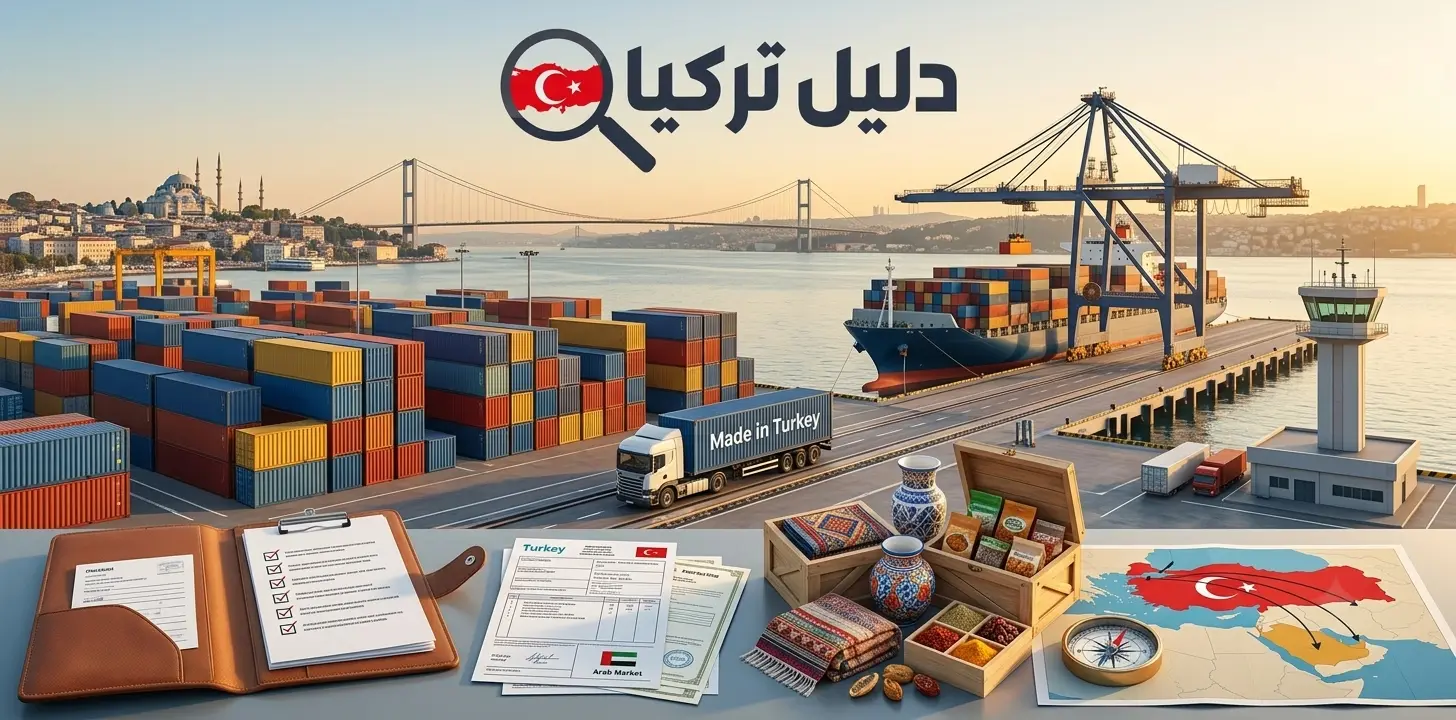
How to Import from Turkey: A Step-by-Step Guide for Arab Buyers Importing from Turkey has become a practical option for many traders and business owners across…
Importing from Turkey has become a practical option for many traders and business owners across Arab markets. Turkey offers a broad range of products, relatively close geographical access, and a large supplier base in sectors such as clothing, textiles, construction materials, furniture, food, packaging, and household goods. However, proximity does not make importing automatic or risk-free. A successful transaction begins long before you contact a factory and continues until the goods are inspected in your own warehouse.
This guide explains the import process from Turkey in a practical, structured way. It covers product selection, supplier sourcing, negotiation, samples, payment, shipping, customs clearance, landed-cost calculation, and risk reduction. It is useful for first-time importers as well as traders who want to make their sourcing process more disciplined and profitable.
Start with the product and target market
One of the most common mistakes is searching for factories before deciding what you want to sell and who will buy it. Do not only ask, “What does Turkey manufacture?” Ask instead: “Which product does my market need? What can the final customer realistically pay? How competitive is the market? Can I still earn a profit after shipping, customs duties, storage, and marketing costs?”
Before choosing a product, study your local market through four basic angles: demand volume, prevailing prices, competitor quality, and product turnover. A product may look profitable on paper but sell slowly, require substantial capital, or need complicated conformity documents in your country. It is usually safer to begin with a product category you understand or where you already have customer access, rather than entering a new category merely because the Turkish factory price appears attractive.
Create a shortlist of three to five possible products. For each product, estimate the expected selling price, target purchase price, minimum order quantity, approximate freight cost, customs duty, lead time, and key risks. This simple exercise helps you make a decision based on numbers rather than assumptions.
Calculate landed cost before requesting quotations
The factory price is not the real cost of the product. A supplier may offer an excellent unit price, but after adding inland transport in Turkey, packaging, freight, insurance, customs duties, port charges, clearance, and delivery to your warehouse, the product may no longer be profitable.
You should therefore work with the concept of landed cost: everything you pay until the goods are inside your warehouse and ready for sale.
Landed cost = product price + packaging + transport within Turkey + freight and insurance + customs duties and taxes + clearance + local delivery + additional fees.
Once you know the landed cost per unit, compare it with the realistic selling price in your market, not with an optimistic price you hope to achieve. Leave room for expenses that may not be obvious at the beginning, such as damaged goods, customs delays, customer discounts, marketing costs, and exchange-rate movements.
For a first import order, do not rely on an extremely narrow margin. A small increase in freight or customs charges can eliminate profit completely. The best product is not necessarily the cheapest one at the factory; it is the product that creates a clear margin after arrival and sale.
Choose the right Turkish city for your sector
Turkey is not one uniform sourcing market. Different cities and industrial centres are known for different sectors. Choosing the right area saves time and increases the chance of finding a suitable manufacturer rather than relying on non-specialist intermediaries.
- Istanbul: Strong for general trade, clothing, furniture, household goods, packaging, cosmetics, food products, and international trade fairs. It is an excellent city for meeting many suppliers, although it is not always the lowest-cost production base.
- Bursa: Important for automotive products and spare parts, textiles, fabrics, some mechanical industries, and furniture.
- Gaziantep: Known for carpets, rugs, food products, plastics, packaging, textiles, and some machinery and industrial goods.
- Konya: Relevant for agricultural machinery, spare parts, metal industries, and some construction and production equipment.
- Izmir and Manisa: Important for food, agriculture, industrial products, and export-oriented activity connected to nearby ports.
- Kayseri: A strong destination for furniture, mattresses, household products, and wood-related industries.
- Denizli: Well known for home textiles, towels, bed linen, and cotton products.
This does not mean that every good supplier exists only in these cities, but it gives you a logical starting point. Before travelling or ordering samples, search for manufacturers in the region that specialises in your sector and compare several options instead of stopping at the first company you find.
How to find Turkish suppliers and factories
Suppliers can be found through trade fairs, chambers of commerce, exporter associations, business directories, wholesale platforms, direct online searches, and recommendations from traders already active in the field. However, finding a company name does not mean that the company is reliable or that it is an actual manufacturer.
When sourcing, try to distinguish among three types of counterparties: manufacturers, trading companies, and intermediaries. A manufacturer may offer a better price and more customization capability, but may require a higher minimum order quantity. A trading company can be useful for smaller quantities or for combining products from several factories, but it adds a margin to the price. An intermediary may simplify communication, but their role and fee should be clear from the beginning.
Request specific information from every potential supplier: legal company name, factory or office address, website, catalogue, product list, relevant quality certificates, production capacity, minimum order quantity, lead time, payment terms, recent factory or production-line photos and videos, and export markets they already serve.
The more organised and clear the supplier’s response is, the more likely the relationship is to be professional. Vague replies, unusually low prices, or pressure to make a quick payment without documents are warning signs that deserve careful attention.
Verify the company before paying money
Supplier verification is not an optional extra; it is a core part of protecting your capital. Even if a supplier appears professional in messages and calls, you should verify its legal existence, commercial activity, and actual capacity to fulfil the order.
Begin by requesting the trade registration document or company registration certificate, tax number, full company address, and the name of the authorised signatory. Then compare these details with the supplier’s bank account. Ideally, the account should be in the company’s own name, not in the name of an unrelated individual.
Ask for a live video call from the factory or warehouse, showing the company name, production line, or real stock. Do not rely on catalogue photos alone; some images may belong to other suppliers or factories. If the order value is significant, visiting the factory personally or appointing an independent inspection company before payment is a sensible business decision, not an unnecessary cost.
Ask for commercial references where possible, such as previous customers or export markets. You should not expect a supplier to disclose every customer detail, but a professional exporter can usually demonstrate experience through documents, certificates, loading images, or general evidence of the markets they serve.
Request a professional quotation
A good quotation should include more than the product price. Ask for a written offer that specifies product name, material, size, colour, quantity, unit price, currency, packaging type, minimum order quantity, production time, payment terms, loading port, agreed Incoterm, and quotation validity.
If you are comparing suppliers, send the same specifications to each one. Do not compare prices for products with different specifications. One supplier may appear cheaper because the material is weaker, the thickness is lower, the packaging is simpler, or the product belongs to a different commercial quality grade.
You should also understand the pricing term. EXW means collection from the factory, with the buyer responsible for everything afterwards. FOB means the supplier prepares the goods and loads them on board the vessel at the agreed port. CIF means the supplier arranges freight and insurance to the destination port, but you must still understand the charges payable after the shipment arrives.
Samples are not a luxury
Do not rely on pictures or videos when buying a new product or working with a new factory. A sample allows you to inspect quality, colour, size, packaging, and materials before committing to a larger order. For clothing and textiles, inspect fabric, stitching, sizing, and colour fastness. For construction materials, examine thickness, durability, colour, and conformity with specifications. For household goods, test actual use, packaging, and resistance to breakage or scratching.
The sample should be linked to written specifications, not merely a phrase such as “same quality.” Keep a photo of the approved sample or send the reference back to the factory, and state in the contract that final production must match the approved sample.
If the product will carry your own brand, request a sample with your logo, labels, and packaging before approving the final design. A small error in a name, size, barcode, or label can make part of a shipment difficult or impossible to sell.
Negotiate the full deal, not only the price
A professional negotiator does not only ask for a discount. In some cases, a supplier cannot reduce the unit price, but can offer better packaging, additional quantities, spare parts, free branding, reduced mould charges, safer payment terms, or a better production schedule.
Minimum order quantities can sometimes be negotiated, especially when the product is already in stock or does not require custom design. For products requiring a special colour, mould, or private packaging, a higher quantity may be reasonable because the factory must cover setup and operating costs.
Be clear about your future plan. If you intend to build a long-term relationship, explain the expected order volume over the coming months, but do not promise quantities you cannot realistically deliver. Commercial trust grows when your commitments are credible.
Use a clear contract or purchase order
Verbal agreements or chat messages alone are not enough for serious transactions. You need a formal contract or purchase order that defines every issue likely to create a future disagreement.
- Legal details of buyer and seller
- Detailed product description and specifications
- Quantity, including any permitted shortage or overage
- Total price, unit price, and currency
- Packaging, marking, labelling, and branding requirements
- Approved sample or technical reference
- Production completion and shipping dates
- Agreed trade term: EXW, FOB, CIF, or another Incoterm
- Payment terms and instalments
- Pre-shipment inspection and the right to reject non-conforming goods
- Procedures for delays, defects, shortages, or claims
- Documents the supplier must provide
The clearer the details, the less room there is for disagreement later. A good contract does not mean you distrust the supplier; it means both parties agree on the same standards before production begins.
Choose a payment method that protects you
The payment method should match the order value and your level of trust in the supplier. Direct bank transfer can be quick, but it carries risk when the full amount is paid in advance. For small orders or established suppliers, it may be common to pay a deposit and then the balance before shipment or against copies of shipping documents.
For larger transactions, consider a letter of credit or another payment structure that provides stronger protection for both sides. Payment can also be divided into stages: a deposit at order confirmation, a payment after production or inspection, and the balance at shipment or against specified documents.
Do not send money to a personal bank account when the contract and invoice are issued in a company name unless there is a clear and legally acceptable explanation. Always make sure that the bank beneficiary name matches the supplier with whom you signed the agreement.
Inspect goods before they leave Turkey
Pre-shipment inspection is one of the most important stages, especially in a first transaction or for a large order. You can inspect personally, use a trusted representative, or hire an independent inspection company. The objective is to confirm that quantity, quality, packaging, and labelling match what was agreed.
A proper inspection includes random production sampling, carton or package counting, comparison with the approved sample, checks of sizes, colours, visible defects, and confirmation that barcodes, brand details, or country-of-origin markings are correct where required.
It is better to inspect before paying the final balance. If a problem is found, the supplier has time to correct it before loading the container or handing the goods to the freight company.
Arrange shipping using the right method
Shipping method should not be chosen based on price alone. Sea freight is often suitable for large volumes and heavy goods, but it takes longer. Air freight is faster but more expensive and is generally appropriate for samples or lightweight, high-value products. Road transport may suit certain nearby markets depending on available routes and product type.
Request clear quotations from more than one freight forwarder. Make sure you understand whether the price includes collection from the factory, export clearance in Turkey, port charges, freight, insurance, and delivery in your country. Do not compare two quotations until you know the exact starting and ending point for each offer.
If you are importing a full container, confirm the appropriate container type and loading method. Fragile goods such as ceramic and glass need different loading and securing arrangements from clothing, plastic goods, or furniture.
Prepare import documents before the shipment arrives
Requirements differ from one Arab country to another and from one product to another, but most import transactions involve documents such as a commercial invoice, packing list, bill of lading, certificate of origin, certificate of conformity or inspection where required, and any health, agricultural, or technical certificates related to the product.
Ask the supplier to send draft documents before final issuance. Review the importer name, address, goods description, quantity, weight, price, country of origin, and invoice number. Even a small difference between the invoice, packing list, and bill of lading can create delays or additional cost at customs.
Speak with a customs broker in your country before shipping, not after the goods arrive. A good broker can tell you the expected duties, required licences, restrictions, specifications, and certificates that should be prepared in advance.
Track the shipment until it reaches your warehouse
Your responsibility does not end when the container leaves Turkey. Follow the bill of lading number, departure date, estimated arrival, and any change in the vessel schedule. Prepare customs clearance, warehouse space, and local transport before arrival to avoid storage and demurrage charges at the port.
At delivery, inspect packages immediately before the carrier leaves, and document any visible damage, shortage, or mismatch in carton count. If the goods are insured, a claim may need to be filed within a limited time, so do not delay documentation.
Build a long-term relationship with successful suppliers
The purpose of a first order is not only to achieve the highest possible profit; it is also to test the relationship. A supplier who meets specifications and deadlines and communicates clearly when problems arise is a supplier worth developing. Over time, you may receive better prices, production priority, more flexible quantities, and more suitable payment terms.
After every shipment, record what happened: price, product quality, production time, document accuracy, shipping costs, problems, and supplier responsiveness. This information becomes a reference for future negotiations and helps you decide which supplier deserves your long-term business.
Mistakes to avoid in your first import order
- Choosing a product based only on factory price without calculating landed cost
- Sending the full payment to a new supplier without verification, contract, or inspection
- Relying on pictures instead of samples and written specifications
- Starting with an order larger than your financial, storage, or sales capacity
- Ignoring customs duties and required certificates in the importing country
- Failing to define packaging, labels, and branding in detail
- Choosing a freight company only because it is the cheapest without understanding what the quotation includes
- Working with one supplier without comparing several offers and specifications
- Waiting until after shipment arrival to speak with a customs broker
- Not keeping an organised record of documents, messages, contracts, and payments
Importing from Turkey can become a profitable and stable business when it is treated as an integrated system: the right product, a reliable supplier, written specifications, accurate costing, organised shipping, and correct documents. Start with a manageable order, learn from the first transaction, and expand once the numbers show that the market, supplier, and logistics are working in your favour.